Back to Blog
September 25, 2026
Built on Miles | Chapter 9
 Knowing When to Say No
Four questions that changed the way I chose what came next
By Daphne Kirkwood, Founder of iDaph Events
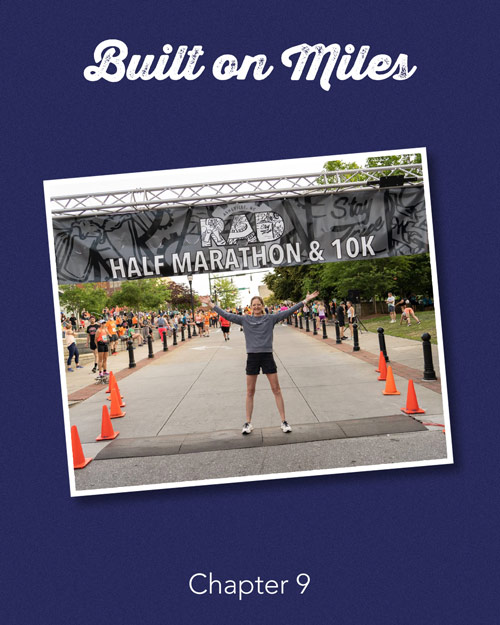
The photograph that accompanies this chapter was taken beneath the finish banner at the inaugural RAD Half Marathon and 10K on June 12, 2022. My arms are open, runners and volunteers are behind me, and the entire scene feels like a celebration. The date carried another meaning for me. Exactly four years earlier, I had learned that I had lymphoma.
I wrote a personal Facebook post that day about feeling fully alive and using every ounce of the energy God had given me. I did not yet understand that it would become one of my last personal posts on social media. I was learning that living fully did not mean giving everything and everyone unlimited access to my energy. It meant choosing more carefully where that energy could do the most good.
Saying no was how I learned to protect my energy for the right yes.
The world was coming back alive in 2022 and 2023, and you could feel it at the start line. People were ready to gather again. They wanted the countdown, the shared nervous energy, the sound of hundreds of feet leaving together, and the celebration at the finish. After staggered starts, small waves, masks, virtual options, and years of uncertainty, mass starts felt almost electric. The running boom was back, registrations were growing, and things were moving quickly.
The crowds were back. So was the energy.
Requests for events also seemed to arrive from every direction. Schools, churches, clubs, and organizations wanted races of their own. After the fear of 2020, saying yes to all of that work could have looked like recovery. Every request represented possible income, another partnership, and another chance to grow.
But COVID had changed the way I thought about growth. I had rebuilt iDaph with a smaller team and a clearer understanding of my own capacity. I knew how much time I had once spent managing people instead of doing the work I loved. I also knew that every race disrupted a community even while bringing visitors, energy, and valuable economic impact. More events did not automatically create a stronger company or a healthier community.
The challenge was no longer whether we could hold events. It was deciding which events deserved to grow.
I needed a better standard than simply asking whether I could make something happen.
Is it safe and sustainable?
The Asheville Off Road Series forced me to answer that question honestly. I loved the variety of the event because it brought together two things I personally loved to do: run and bike. A duathlon with a run, bike, and second run unfolded alongside three gravel races, all in the same event space. Seeing those different athletes and disciplines come together was the kind of magic that made me want to produce events in the first place.
After moving the series to Hendersonville, however, the participation numbers were too low to support the cost and complexity. The available mileage for a strong gravel course was becoming more limited, and we were hearing increasingly specific dissatisfaction about the course, parking, and other details. More importantly, signs were being disturbed or removed in rural areas, and cyclists who were riding or previewing the route experienced threatening behavior. I could not feel confident that the course would remain intact or that participants would be safe.
That was enough. Safety is not something I will negotiate in order to keep an event alive. The decision still hurts because events can feel like little children born from my mind. I imagine them, plan every part, introduce them to the community, and watch them become something real. Ending one can feel like admitting that all of that care was wasted, even when the facts say otherwise.
Loving an event was not enough reason to keep it.
The facts were clear with the Off Road Series. Participation was not supporting the expense, the course options were narrowing, and the safety concerns had become too serious. Continuing simply because I loved the idea and the sports would not have served the athletes, the community, or iDaph. Saying no to another year was not giving up. It was accepting my responsibility as the event director.
Does it fill a meaningful need?
Once I understood that not every existing event should continue, I also became more selective about new ideas. I did not want to produce a surplus of races that felt interchangeable. Other event companies were entering the area, and I worried about oversaturating communities that already had to absorb road closures, traffic, noise, and crowds. If an event did not excite me or carry a clear purpose, I knew it would begin to feel like a chore. That was not a healthy foundation for the level of care I wanted to bring.
Every event had to earn its place on the calendar.
Bark and Bolt earned its place because it filled a gap. We had helped with Run for the Paws for years, and after that race ended there were very few events built around people moving with their dogs. I love animals, and the idea felt playful and distinct from everything else we were producing. The 5K, one mile, and 100 meter dog dash invited an entirely different community into an iDaph experience. It was not another version of an event we already had. It had its own personality and a reason to exist.
TreeTops Trail Race also began with a meaningful place and purpose. DuPont State Recreational Forest is one of the great playgrounds in the woods of Western North Carolina. We had produced trail races there before, but permitting changed during COVID and those events moved elsewhere. I wanted to bring a race back to DuPont, but only if it could support something larger than the race itself.
Partnering with Friends of DuPont and adding TreeTops to the DuPont Forest Festival gave the idea that purpose. Runners could discover the forest and the festival, while more people could learn about the work required to protect such a special place. Around this period, I became even more convinced that every iDaph event should have a local nonprofit partner. We had valued those relationships for years, but I wanted the connection to be intentional and tied to a mission I believed in.
Do the place and partners fit?
A good event can struggle when it has outgrown its home or when the partnership no longer provides what the experience needs. The Ugly Sweater Run had become too large for the parking available at the Riveter and the course was not one of my favorites. Parking and course flow may sound like a small detail until it becomes the barrier that keeps a race from growing safely and smoothly. I did not want to wait for the limitation to become a larger problem.
Oskar Blues Brewery had been an excellent partner for the ride we produced for the Blue Ridge Bicycle Club, so I asked whether the brewery might welcome the Ugly Sweater Run during a quieter part of its calendar. They said yes. The move gave the race more room and a partner that understood the energy of an active community gathering. It also reminded me that saying no is not always an ending. Sometimes it means saying no to the wrong fit so an event can find a better home.
I began looking at every new request through the same lens. Did the event belong in that place? Did the host understand what a race would ask of its neighbors? Was the partnership strong enough to support the participants, volunteers, and community? Did the idea mean something to me personally? A race could offer economic value and still be the wrong event for that location or the wrong project for iDaph.
Can we give it the quality it deserves?
For me, quality means treating each event as its own small business. The course, medals, shirts, partnerships, nonprofit connection, volunteers, communication, and event day experience all need attention. Even when a race happens in February, it is on our minds in August. The work is not something we can begin a few weeks before the start and expect to do well. A high quality event requires a year round commitment of thought, care, and energy.
Coming out of COVID, I knew I did not want to rebuild the large team we had before. I like doing the work, and I wanted a structure that kept me close to the details without returning me to spending most of my time managing people. As the new structure took shape, Amy became my right arm for administrative support. We built around a strong marketing core, dependable contractors, and event day people who could work in any weather, lift and carry what needed to move, stay calm, and have my back.
That smaller structure made us efficient, but it also required honesty. Even now, iDaph has only one other full time team member besides me. There will always be more ideas than we can responsibly produce. If we say yes beyond our capacity, the quality of every event begins to suffer, the team becomes depleted, and I lose the energy that makes the work personal and creative.
Protecting that energy also meant creating boundaries after an event. I stopped feeling obligated to post on my personal social media accounts, and I learned not to read every comment while I was still physically and emotionally depleted. After giving everything to an event, even a complaint about something like the number of portajons could feel much larger than it was. I needed time to recover before I could separate useful feedback from someone simply being unhappy and then make thoughtful changes for the next year.
I became equally careful about drama in my personal and professional life. When a relationship repeatedly brought conflict or pulled me away from the work and people that mattered, I learned to step away. I try to address problems early, and I no longer believe I have to stand inside every argument. Boundaries are not a lack of care. They are part of caring for the energy the work requires.
Looking back
Saying no still did not feel easy. Sometimes it felt as if I were turning away income at the exact moment the business was growing again. But I also knew that when something leaves, it creates space. That space can become a better event, a stronger partnership, a healthier team, or simply enough room to do the existing work exceptionally well.
Between 2022 and 2023, iDaph was not becoming smaller in ambition. We were becoming more intentional. We let the Off Road Series end when it was no longer safe or sustainable. We launched Bark and Bolt because it welcomed an overlooked community. We created TreeTops with a mission centered partnership, and we moved the Ugly Sweater Run so it could continue to grow with the right host. At the same time, we declined projects that might have filled the calendar but would have pulled our focus away from the experiences we were already committed to creating.
The most important shift was internal. For years, one of my greatest strengths had been the willingness to figure out almost anything. By this point, I understood that being capable of producing an event did not always mean I should produce it. Leadership was no longer only about finding a way to say yes. It was also about recognizing when safety, purpose, partnership, quality, or my own capacity required a clear no.
I was not building less. I was choosing more carefully what was worth building.
Those choices left more room for the work at the center of iDaph: creating amazing experiences that help people move, connect, and feel part of something. They also made the relationships around each event more important. The races that remained were never mine alone. They were shaped by the places that welcomed them, the nonprofits that gave them purpose, and the people who believed the experience was worth building together.