Back to Blog
October 20, 2026
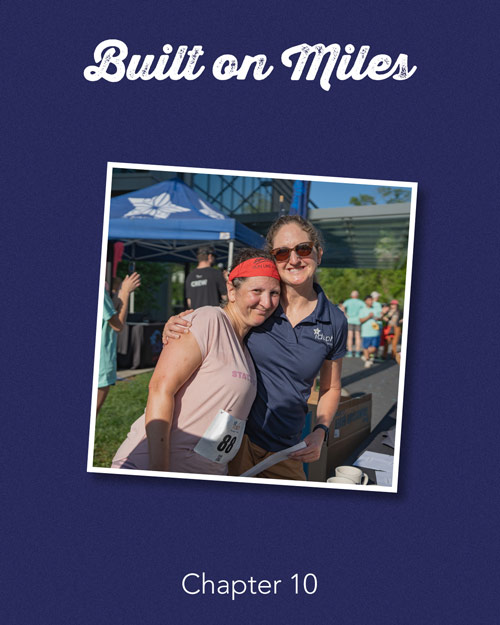
Built on Miles | Chapter 10
 Built With Community
How relationships, trust, and belonging became the heart of iDaph
By Daphne Kirkwood, Founder of iDaph Events
When I first started running in 2002, one of the things I loved most was discovering that there were other people who enjoyed doing the same thing I did. I might run alone most days, but when I showed up at a race, I was surrounded by people who understood why I would willingly get up early on a Saturday morning to run several miles.
I had found my people.
I didn't realize then how much that feeling of belonging would influence the business I would eventually create.
By 2024, iDaph had been producing events for more than a decade. We had established races, longtime partners, a team of employees and contractors, and a growing community of participants who returned year after year. I had learned plenty of lessons about building a business, choosing the right events, and knowing when something was no longer a good fit.
But I was also beginning to understand that the relationships surrounding our events were just as important as the events themselves.
A race might begin with an idea, but it takes a community to bring it to life.
1. Relationships are built on trust
One of the things I've learned over the years is that you can't simply show up in a community with a race idea and expect everyone to welcome it with open arms.
Events affect roads, neighborhoods, businesses, parks, and the people who live and work nearby. They require cooperation from local governments, law enforcement, sponsors, nonprofits, volunteers, and sometimes people who don't have any interest in running at all.
And trust takes time.
When iDaph was new, I didn't have years of successful events behind me. I had to prove that I could do what I said I was going to do, that our events would be organized and safe, and that we cared about the communities where they took place.
Even today, when we bring a new event into a town, I know that trust isn't automatic. Sometimes relationships take longer to develop than I would like. Sometimes people are skeptical of a new idea or protective of something they've spent years building themselves.
I understand that. I've learned not to take it personally.
Over time, showing up, following through, listening, and doing good work have become the best ways I know to build those relationships.
Some of our partnerships have now lasted well over a decade. The Lelia Patterson Center, Blue Ridge Bicycle Club, Asheville Chamber, Biltmore Park, Hunter Subaru, and our local government and parks partners have all been part of our journey in different ways.
There are also individuals behind those organizations who have made a lasting difference. People like Jon with the City of Asheville, who has worked with us through the permitting process since the early years. And the many police officers, Henderson County VIPs, parks staff, ambassadors, and community members who continue to help us make race day happen.
These relationships weren't built through one event or one conversation. They were built over years of working together, solving problems, and learning to trust one another.
The longer I do this work, the more I appreciate the people who keep showing up.
2. Giving back became more intentional
When I started iDaph, most races in our area were produced by nonprofits, running clubs, or community organizations. There weren't many for-profit race production companies, and I sometimes felt there was a perception that because iDaph was a business, our events weren't as deserving of community support.
That bothered me.
Why couldn't a small business be successful while also doing good things for the community?
I've always been a problem solver, and in the beginning, part of my response was to make sure our events had nonprofit partners. I'll admit that I didn't always know what made a good partnership. Sometimes I chose organizations because they were well known or because I thought they could provide a lot of volunteers.
I was learning as I went.
Over time, I realized that the best partnerships weren't necessarily with the largest nonprofits or the ones with the most volunteers. They were with organizations whose missions I believed in and people I genuinely wanted to work alongside.
I began taking more time to get to know the executive directors, understand their goals, and think about how our events could help support their work.
We're a small business, and the donations we make aren't going to change the financial future of a large nonprofit. But for a smaller local organization, those dollars, the exposure, and the relationships that come from an event can make a meaningful difference.
Today, every iDaph event has some connection to a nonprofit or community organization, whether participants realize it or not. I love that we can support different organizations throughout the year and introduce our participants to causes they might not have known about otherwise.
What began partly as a way to establish ourselves in the community has become something much more personal and authentic.
3. Finding a better way to bring people into the experience
Volunteers have always been essential to our events, but finding dependable people to help on race day hasn't always been easy.
For years, we worked with nonprofit organizations that committed to providing volunteers in exchange for donations. While some partnerships worked beautifully, others were challenging.
An organization might promise ten volunteers, but getting all ten to show up on a cold or rainy race morning could feel like pulling teeth. Sometimes the people who arrived weren't familiar with our events or didn't understand what was expected of them.
I started wondering if there was a better way to involve the people who already loved our races.
In 2024, we introduced a new volunteer incentive program that encouraged our participants, friends, and families to get involved behind the scenes. We wanted to create something that rewarded people for giving their time while making it easier for them to stay connected to our events.
What started as a practical solution to a staffing challenge became something much more meaningful. Our participants got to experience race day from a completely different perspective and see just how much planning, preparation, and hard work goes into producing an event.
We don't just show up, pop up a tent, and start a race!
And we started getting to know these people in a different way, too. Some of our most enthusiastic participants are now people who regularly volunteer with us. It's become another way to build relationships and give our community a chance to be part of what we do.
4. When a race becomes something more
In 2024, we launched She Slays, an event that was especially meaningful to me because of my own experience with cancer.
I wanted to find a way to support women in Hendersonville who were facing cancer of all kinds, and partnering with the Pardee Hospital Foundation and its Women Helping Women program gave us an opportunity to do that.
She Slays was never meant to be just another 5K. I wanted it to be a place where women could come together, run, walk, celebrate, support one another, and feel strong.
One of my favorite stories came from a volunteer who witnessed a woman participating in the race recognize one of the healthcare professionals who had helped her through cancer treatment.
She suddenly stopped, gave that person a huge hug, and said, "I wouldn't be here without you."
The volunteers who witnessed it were in tears.
When I heard that story, I immediately thought of Elizabeth, one of my nurses during cancer treatment. She helped me through some incredibly difficult treatment days and even now, whenever I see her, I light up. I'm so grateful for the care she gave me.
I understood exactly what that woman was feeling.
Moments like that remind me that what happens during a race can be so much bigger than the race itself.
5. Creating events that belong to their communities
As we continued developing new events in 2024 and 2025, I became even more intentional about where we produced them and who we partnered with.
I didn't want to simply bring a race into a town, close some roads, and leave. I wanted our events to fit the places where they were held and offer something meaningful to the people who lived there.
When we asked our running community where they would like to see a new event, Brevard was the clear favorite.
Several endurance events in Brevard had disappeared over the years, and people wanted opportunities to race there again. So in 2025, we launched the Brevard Classic.
Bringing a new event into an established community takes patience. You have to build relationships, understand what already exists, and demonstrate that you're there to contribute rather than compete with what others have worked hard to create.
Our relationship with Heart of Brevard has continued developing, and the Brevard Classic is now becoming part of White Squirrel Weekend, one of Brevard's biggest annual celebrations.
To me, that's what a good community partnership should look like. An event that complements what's already happening and gives people another reason to come together.
I've learned that the most successful events aren't always the biggest ones. They're the ones that feel like they belong.
6. Finding my own sense of belonging
There's another part of this story that's more personal.
Today, I live in downtown Hendersonville, close enough to walk or ride my bike to so many of the places I love.
I'm out on the Ecusta Trail, walking through town, or riding my bike, and it's not unusual for someone to call out, "Hey, Daphne!" It has reminded me how connected this community has become for me.
I know my neighbors. I recognize people from our events. I serve on local boards, visit local businesses, and run into friends and familiar faces almost every day.
Most of the time, I love it.
Of course, there are days when my introverted self would prefer to hide out at home, especially after a long, race weekend when I've spent hours talking to people and making decisions!
But there's something really special about living somewhere that people know you and you know them.
Growing up, I moved around a LOT, and I don't remember having that kind of connection to one place. Even when I lived in Asheville and Brevard, I was often in neighborhoods outside of town.
Living inside the city of Hendersonville has changed that.
And it's also changed how I think about producing events.
When we host a race here, these aren't just roads on a course map. They're the streets I travel, the parks I visit, the trails I use, and the neighborhoods where my friends and neighbors live.
I know our events bring energy, visitors, and economic activity into a community, but I also know they can create inconveniences.
I care deeply about both sides of that.
I'm not just coming into town to produce an event and leaving afterward. I live here. I'm part of this community, and I want our events to be something our neighbors feel good about having here.
Looking back
When I think about what iDaph has given back to Western North Carolina over these fifteen years, I don't immediately think about the number of races we've produced or the amount of money we've donated.
I think about the people.
I hope we've helped create memories that people will carry with them for the rest of their lives. Memories of training on cold mornings or hot summer evenings, showing up when they weren't sure they could do it, and crossing a finish line feeling proud of themselves.
I hope our events have helped people find healthier ways to manage stress and anxiety, make new friends, discover places they love, and feel connected to something outside of their everyday routines.
And I hope they've had fun.
Life can be hard and serious enough. I want people to come to our events, challenge themselves, laugh, celebrate, and leave feeling good about what they've accomplished.
Even when the race itself was hard.
Especially when it was hard.
When I started iDaph, I was scrappy. I was figuring out how to build a business, who to work with, and how to create events that people would want to come back to.
Today, I have the experience and freedom to be more intentional about the events we produce, the communities we work in, and the people and organizations we partner with.
That feels like an incredible privilege, and it's something I don't take for granted.
Looking back, I realize that while I was spending all these years creating opportunities for other people to find connection and belonging, I was finding those same things for myself.
I started out looking for my people. Somewhere along the way, we built a community together.