Back to Blog
July 18, 2026
Built on Miles | Chapter 7
Five Things That Kept Me—and iDaph—Moving Forward 
By Daphne Kirkwood, Founder of iDaph Events
At the end of Chapter Six, iDaph had become more than an idea.
The paperwork made it legal.
The shirt made it real.
The office made it official.
By 2017, the business was growing in ways people could see. We were producing more races, supporting established events, creating community programs, making videos, and building a team.
From the outside, it probably looked exciting.
And it was.
But that wasn’t the whole story.
Behind every new program, event, partnership, and smiling race-day photo was an enormous amount of work that most people never saw.
There were relationships being built.
Systems being improved.
People being trained.
Problems being solved.
Risks being taken.
Trust being given—and sometimes lost.
There were also personal battles happening alongside the business. Some were public. Others were carried quietly while the work continued.
During those years, I learned that growth isn’t only about what you create.
It’s also about what you carry, how you adapt, and what keeps you moving forward when you cannot see what is waiting around the next corner.
Looking back, five things stand out about the work no one saw.
1 - We were building community before the start line
I have always believed that a race can change someone’s life.
But before a person signs up for a race, they need to believe they belong there.
They may need a welcoming place to begin.
A coach who will answer their questions.
A group that won’t make them feel too slow, too inexperienced, or too intimidated.
In 2017, I saw a real need for welcoming, coach-led swimming opportunities in our community. Group swimming could be difficult to break into, especially for someone who was new to the sport. Many people wanted to swim but didn’t know where to start or where they would fit.
So we launched the Asheville Swim League under the iDream Athletes Foundation.
The program offered coach-led group swims during the summer and winter. It was free or donation-based and open to all abilities.
Advanced swimmers came.
Experienced triathletes came.
Complete novices came.
They shared lanes, learned from coaches, developed confidence, and became part of a community.
The goal wasn’t to pressure everyone into racing. It was to give people a place to begin.
I wanted to help people build the roots first.
Learn to swim.
Become comfortable riding a bike.
Move their bodies alongside other people.
Discover what they were capable of.
And then, someday, if they wanted to, they could participate in the pinnacle experience: a race.
During this period, iDaph also began supporting the Blue Ridge Bicycle Club’s WNC Flyer and the Asheville Chamber Challenge.
These events already existed. We didn’t create them. Their organizations hired us to help strengthen and produce them.
That distinction mattered.
iDaph was becoming more than a company that created its own races. We were becoming a trusted resource for other organizations that wanted their events to be organized, sustainable, and thoughtfully produced.
In 2019, we also launched the South Asheville Turkey Trot, which would eventually grow to more than 1,750 participants.
The race calendar was growing, but so was the community around it.
That was always the bigger goal.
2 - Building a company meant building—and rebuilding—a team
During 2017 and 2018, I had one or two full-time employees.
For someone who had spent years making nearly every decision and carrying most of the responsibility, building a team was a major transition.
It meant trusting people.
Sharing information.
Delegating work.
Letting other people represent the company carrying my name.
Then, during one of the most vulnerable periods of my life, I experienced a painful loss of trust within the team.
I was undergoing cancer treatment and already carrying more than I knew how to process. At the same time, I had to make difficult business decisions and begin building a new team.
There wasn’t time to stop everything while I recovered emotionally or figured out the perfect next move.
The races were still on the calendar.
Participants were still registering.
Clients were still depending on us.
The work still had to happen.
I knew I would need more support while going through treatment, so I committed to rebuilding. By the time we approached 2020, iDaph had grown to a team of five full-time employees, along with additional contract help.
That growth wasn’t only about taking tasks off my plate.
It was about creating a company that could continue functioning even when I could not personally carry every piece of it.
Rebuilding required me to trust again.
It also required me to accept something that had always been difficult for me: needing support was not the same thing as being incapable.
3 - Fun became part of how we made it through
As the team grew, I wanted us to work hard and take our responsibilities seriously.
But I also wanted us to have fun.
Stephanie Buss introduced me to Keith Wright, who became the magician behind some of the most creative and hilarious videos iDaph had ever produced.
Keith was the mastermind of fun.
We created themed YouTube videos that were deliberately quirky and intentionally out there—especially compared to what other race companies were doing at the time.
We made an educational series intended to help other event organizers. I thought iDaph might eventually be hired to do more consulting, so we created videos sharing what I had learned about event production, including how to take the stress out of event planning.
We created a video in which I hired Tour de France legend George Hincapie to become my personal domestique.
We also created a wonderfully ridiculous introduction to the iDaph team.
At the time, filming sometimes felt like another thing I had to do.
There were already races to plan, emails to answer, employees to lead, and treatments to manage. Showing up to make a funny video could easily feel like one more item on an already overwhelming list.
But I didn’t realize how much I needed that fun.
There were costumes.
Absurd ideas.
Moments when no one could keep a straight face.
And lots of belly laughs.
Keith brought lightness into an incredibly challenging, sad, and difficult period. The videos helped keep me and the team in good spirits when we needed it most.
They also reminded us that professionalism and personality could exist together.
We could take the work seriously without taking ourselves seriously all the time.
Looking back, those videos weren’t a distraction from the work.
They were part of what helped us keep doing it.
4 - People knew I had cancer—but they didn’t see everything it required
On June 12, 2018, I was diagnosed with follicular lymphoma.
The diagnosis wasn’t something I completely hid. I shared updates on my personal social media pages and raised money for the Leukemia & Lymphoma Society to support the search for a cure.
There was also a connection I never could have anticipated.
When the Asheville Marathon first launched in 2013, the Leukemia & Lymphoma Society was our first charity partner.
At the time, I was helping support other people facing blood cancer.
Five years later, I needed their advice, services, and support for my own battle with lymphoma.
In 2019, Keith helped me share part of that journey through a video about living with lymphoma.
I felt an extra urge to show people how strong and capable I was throughout treatment.
Crystal, one of our iDaph ambassadors, had battled breast cancer several years earlier. She became a model for me. She showed people that a cancer diagnosis did not mean life had to stop.
She continued living.
She continued moving.
She continued showing up.
That was the example I wanted to follow.
There was another layer of pressure too.
I was a woman leading a company in a male-dominated industry and society. Event production is an intense career with enormous responsibility. I already felt pressure to prove that I could handle it.
After my diagnosis, that pressure became even stronger.
I didn’t feel like I could show weakness publicly.
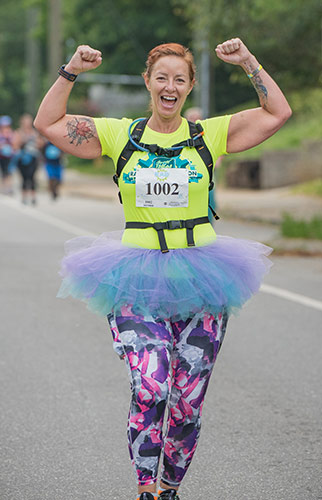
During events, I zipped everything up and put it on a shelf.
I smiled.
I made decisions.
I solved problems.
I supported the team.
I kept iDaph running.
There were days when I wanted to sit down and cry. But in order to survive what I was going through, I felt like I had to keep the business moving smoothly.
People knew I had cancer.
What they may not have seen was the energy it took to continue leading through two and a half years of treatment.
They didn’t always see the exhaustion.
The anxiety.
The difficult decisions.
Or how hard I was working to appear strong while figuring out how to become strong in an entirely different way.
5 - Strength became something different
For a long time, I believed strength meant continuing.
Keep working.
Keep running.
Keep producing.
Keep showing everyone that I could handle it.
But treatment began teaching me something else.
Sometimes strength meant taking a nap.
Sometimes it meant balancing running with something gentler.
Sometimes it meant admitting that I needed more people around me.
In 2018, I became diligent about practicing yoga.
I needed something that would ground me during an extremely anxiety-driven period. Yoga made me stop. It made me slow down, breathe, and reconnect with the spiritual part of myself.
It taught me how to sit with discomfort instead of always trying to outrun it.
To sit with struggle.
To listen to what I wanted and needed.
To pay attention to how I was actually feeling.
That practice remains part of my life today.
Yoga also helped me understand the importance of putting on my own oxygen mask first.
If I wanted to show up as a positive light for my team and community, I had to take care of myself too.
That didn’t come naturally.
I was accustomed to being the person with the answers—the one who figured things out, solved the problem, and kept everything moving.
But strength isn’t knowing all the answers.
Strength is being brave enough to take the very next small step forward and see what is around the next corner.
And one of the biggest corners was still ahead.
In March 2020, the Asheville Marathon was ready to go.
Nine Go Minis were loaded with equipment.
The medals had been purchased.
The shirts were ready.
The bibs were printed.
Thousands of runners had trained for months, booked hotel rooms, and made travel plans.
Then, within days, everything changed.
Government orders related to COVID-19 forced us to cancel the race. It was one of the first major races in the country to face that decision.
There was no guide for what to do next.
No system built for canceling an event of that size at the last minute.
No way to make everyone happy.
The financial risks were significant. So were the personal and reputational ones.
I was finishing cancer treatment while trying to lead a company through a crisis none of us understood.
Once again, the only option was to take the next small step.
Then another.
And another.
Eventually, those steps would lead to socially distanced Pop-Up 5Ks, point-to-point races, and several events that would become some of iDaph’s most enduring experiences.
But that is the next chapter.
Looking back
When people see a race, they see the start line.
The finish.
The medals.
The celebration.
They don’t always see the years of community-building that helped someone feel ready to register.
They don’t see the trust required to build a team—or the courage required to rebuild one.
They don’t see the laughter that keeps people going during a difficult season.
They don’t see the naps, the yoga practice, the anxiety, or the moments when the person making every decision is unsure what to do next.
And they don’t see the hundreds of small steps underneath every big one.
That was the work of this season.
Building community.
Building a team.
Building trust again.
Building space for joy.
And learning how to build a life that could hold both strength and struggle.
I still believe in waking up each day with the drive to be better, do better, and show up as a bright light—for myself and for my community.
But I no longer believe strength means having every answer.
Sometimes strength is simply being willing to take the next step.
And trusting that when you reach the corner, you will find a way forward.